Search the guides available to you, then use categories to narrow the list by workflow.
Overview
Use Support Guides
Search and filter Wake Logger guides from the Support page.
Search support guides:
Open `/support`.
Type a term into the search box.
Review matching guide titles, categories, and snippets.
Select a search result to jump to that guide.
Clear the search box to return to the full category view.
Browse by category:
Use the category buttons on the left side of the Support guides section.
Select `All Guides` to show every guide available to your account.
Select a specific category such as `Uploads & Import`, `Trip Review`, `Maps & Layers`, `Sharing`, or `Premium` to narrow the page.
If a category has no visible guides for your access level, the page tells you no guides are available there.
Reviewed 2026-05-06
Overview
Wake Logger Overview
Understand how Wake Logger turns personal and vessel trips into maps, records, reports, and public stories.
What Wake Logger does:
Wake Logger records boating trips for individual users, vessel owners, and crew.
A trip can stay personal with no vessel attached, or it can be linked to a vessel so owner, manager, and crew workflows apply.
Uploaded source data becomes a trip record with a route map, dates, distance, speed/course details when available, environment summaries, media, activity history, and report outputs.
Manual trips and manual routes are available when you need to record a trip without a complete GPS file.
Reports and public pages are generated from the trip and vessel records in Wake Logger, not from edited exported files.
Where to find outputs:
Use the workspace to review trip cards, vessel scopes, personal scope, public trips, and recent activity.
Open a trip detail view to inspect the route, track playback, media, crew, and available environment data.
Open `/activity` to review upload timelines, crew requests, support replies, and background job updates.
Open `/reports/{voyageId}` when you need the report view or PDF export for a trip.
Publish only the profiles and trips you intend to share publicly; private workspace trips and media remain private until deliberately published.
Reviewed 2026-05-06
Overview
Start with Wake Logger
Create an account, sign in, confirm your timezone, and understand the first workspace view.
Create your account:
Open `Register` from the public site header.
Enter your display name, email address, password, and timezone.
Submit the form.
When registration completes, continue into the signed-in workspace.
If you already have an account, use `Sign In` instead of registering again.
Check the first workspace view:
Confirm the profile menu shows your signed-in account.
Review the workspace options for creating a vessel, joining or finding a vessel, uploading a trip, or continuing with personal trips.
Open the profile menu and note the account-level pages: `Account`, `Activity`, `Billing`, `Support`, and `Workspace`.
Before uploading a trip, go to `Account` and confirm your timezone is correct.
Return to the workspace when the account details are correct.
Reviewed 2026-05-06
Overview
Wake Logger Page Directory
Use this directory to understand what each Wake Logger page is for and where to go next.
Core public pages:
`/` is the public home page for signed-out visitors and the workspace entry point for signed-in users.
`/public/trips` lists recent public trips for signed-out visitors.
`/support` opens support tickets and searchable support guides.
`/contact` is the signed-in contact request page.
`/terms`, `/privacy`, and `/refunds` explain service, privacy, cancellation, and refund policies.
Account access pages:
`/register` creates a user account.
`/login` signs in an existing user.
`/email-change/{token}` confirms a requested email change.
`/invite/{token}` accepts an account or vessel invite.
`/owner-setup/{token}` completes owner vessel setup from an owner-claim link.
Signed-in user pages:
`/account` manages avatar, profile settings, email, password, and account invites.
`/activity` shows notifications, upload timelines, and crew review requests.
`/billing` manages premium subscriptions and billing self-service.
`/support` creates and tracks support requests.
`/upload-trip` uploads trip files and assigns crew.
`/vessels/manage` is the main signed-in workspace for scopes, vessels, crew, trips, reviews, custom marks, and vessel analytics.
Trip, reporting, and premium pages:
`/reports/{voyageId}` shows the trip report and PDF exports.
`/race-analytics/{voyageId}` opens AI Sailing Captain for eligible trips.
`/formal-logging` supports formal trip log records where the workflow is available.
Public profile and trip pages:
`/u/{slug}` shows a public user profile.
`/u/{slug}/trips/{tripSlug}` shows a public trip owned by a public user profile.
`/v/{slug}` shows a public vessel profile.
`/v/{slug}/trips/{tripSlug}` shows a public trip connected to a public vessel profile.
`/public/trips/{voyageId}` shows a read-only public trip by voyage id.
Reviewed 2026-05-06
Overview
Home, Register, and Sign In Pages
Use the public home page, create an account, sign in, and recover the intended next page after authentication.
Use the home page:
Open `/`.
If you are signed out, review the public Wake Logger overview and navigation.
Use `Sign In` if you already have an account.
Use `Create Account` or `Register` if you are new.
Use public trip and document links to inspect the app before signing in.
Create an account from `/register`:
Open `/register`.
Enter your email address.
Enter your display name.
Enter a password that meets the page requirements.
Choose timezone, unit system, home region, and onboarding intents when those fields are shown.
Submit the form.
Continue to the workspace or the `next` page if you were sent to registration from another workflow.
Sign in from `/login`:
Open `/login`.
Enter your account email.
Enter your password.
Submit the sign-in form.
If the page URL includes `next`, Wake Logger returns you to that destination after sign-in.
If you do not have an account, use the register link shown on the sign-in page.
Reviewed 2026-05-06
Vessels & Crew
Create and Manage Vessels
Create vessel profiles, choose vessel scope, maintain ownership details, and control shared access.
Create a vessel:
Sign in and open the workspace.
Choose the vessel area or `Create New Vessel` action.
Enter the vessel name first.
Add the profile details you know, such as make, model, measurements, propulsion type, owner details, registration number, and call sign.
If the vessel should have a public page, set the public slug and enable the public vessel profile.
Save the vessel.
Select the vessel in the workspace before creating or uploading trips that belong to it.
Work in the correct scope:
Use personal scope for trips that should belong only to your account.
Use vessel scope when a trip should inherit vessel identity, crew roles, vessel sharing, and vessel access.
Confirm the selected scope before uploading a trip or changing crew settings.
Manage crew access:
Open the vessel management area for the selected vessel.
Review current crew or access members.
Create or adjust vessel roles where needed.
Invite users or respond to access requests.
Recheck the vessel before publishing or reporting trips that depend on crew assignments.
If you are asked to sign in or create an account, complete that step first.
Accept the invite.
Continue to the workspace.
If the invite is expired, revoked, or already used, ask the sender to resend or create a new invite.
Complete owner setup from `/owner-setup/{token}`:
Open the owner setup link.
Review the vessel setup or owner claim details.
Sign in or create an account if prompted.
Confirm the owner setup information.
Submit the setup form.
Open the workspace and check that the vessel appears under your access.
Use invite links safely:
Treat invite links as account access links.
Do not forward them unless the sender intended that.
If a link does not work, use Support or ask the owner/admin to revoke and recreate it.
Reviewed 2026-05-06
Uploads & Import
Upload Trips
Upload GPX, NMEA, DAT-family, CSV, KML, or GeoJSON trip files and follow the persisted progress timeline.
Upload a trip file:
Sign in.
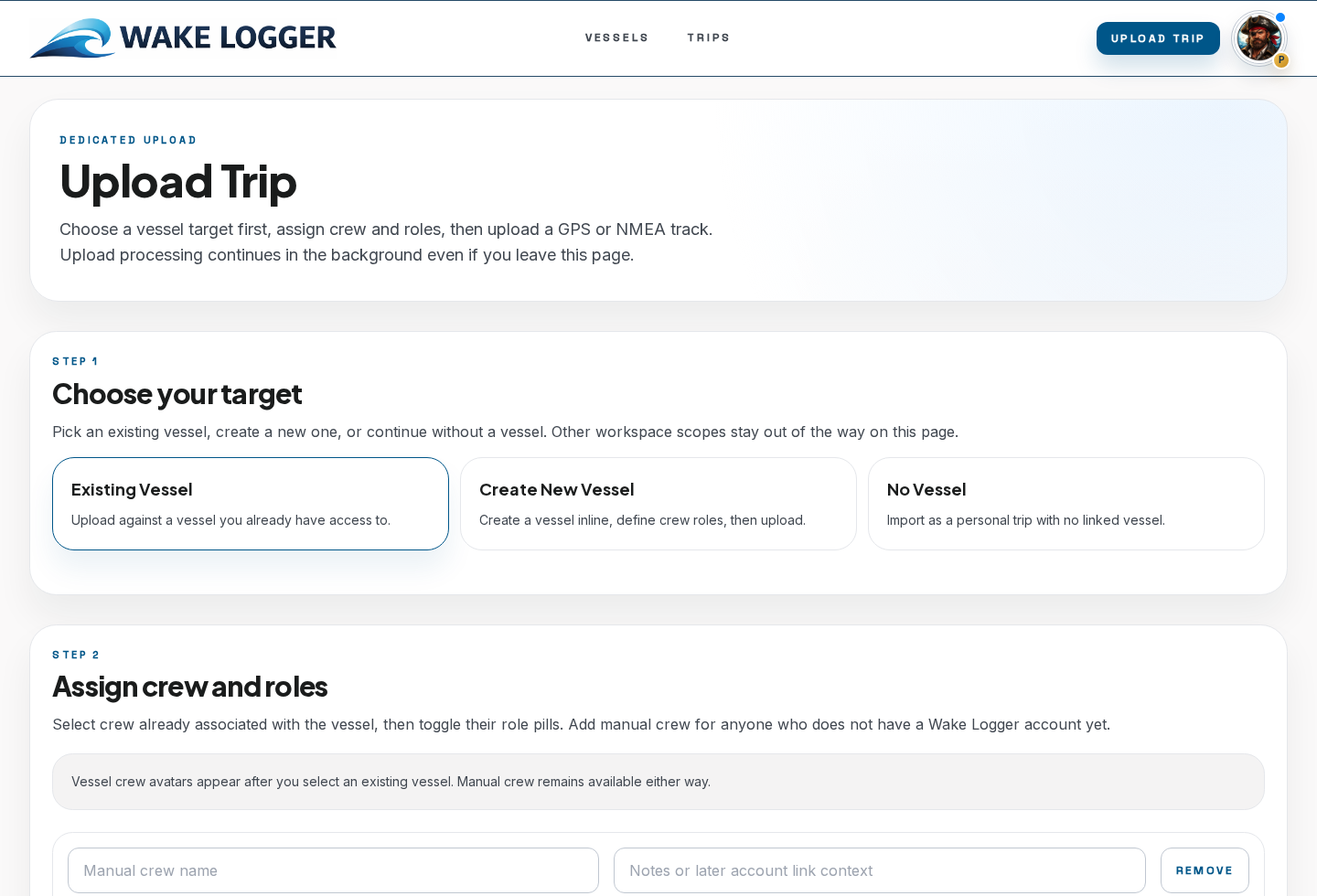
Select the correct workspace scope: personal or the vessel that owns the trip.
Open `Upload Trip`.
Choose the trip file from your device. Supported import families include GPX, NMEA, DAT-family files, CSV, KML, and GeoJSON.
Check any visible vessel or trip options before submitting.
Use `Share this trip publicly` when the trip is suitable for your public profile or vessel public profile. Vessel uploads follow the vessel's public-trip default, and you can change sharing later from the trip controls.
Select the upload button.
Watch the progress panel that appears below the upload button.
Sign in.
Select the correct workspace scope: personal or the vessel that owns the trip.
Open `Upload Trip`.
Choose the trip file from your device. Supported import families include GPX, KML, GeoJSON, CSV, DAT-family NMEA 2000 logs, and ZIP archives of DAT files.
Check any visible vessel, crew, or trip options before submitting.
Select the upload button.
Watch the progress panel that appears below the upload button.
Read the progress timeline:
Wait until the file storage step completes.
When the page says it is safe to leave, you may navigate away while background processing continues.
Review each timestamped step in order.
For GPX, KML, GeoJSON, or CSV files, expect GPS-oriented parsing, point normalization, and enrichment-oriented steps.
For NMEA or DAT files, expect identification and decode steps when Wake Logger can report them.
Common outcomes include successful import, partial import, skipped enrichment, failed enrichment, invalid file, and insufficient track data.
If weather, tide, current, or wave enrichment fails but the import succeeds, treat the trip as imported and review the failed enrichment step separately.
Open `Activity` later if you need to review the same upload timeline again.
Reviewed 2026-05-06
Uploads & Import
Trip Upload CSV Specification
Prepare a CSV GPS track file that Wake Logger can import as a trip track.
Use this CSV format for trip uploads:
Save the file with a `.csv` extension.
Use UTF-8 text.
Use a comma-separated header row.
Keep one track point per row.
Keep the uploaded file under 20 MB.
Upload it from `Upload Trip` after selecting the correct personal or vessel scope.
Required location columns:
Include one latitude column named `lat` or `latitude`.
Include one longitude column named `lon`, `lng`, `long`, or `longitude`.
Use decimal degrees.
Use negative latitude for south and negative longitude for west.
Rows without both latitude and longitude are ignored as track points.
Optional time columns:
Add one timestamp column named `time`, `timestamp`, `datetime`, or `date_time`.
Use ISO 8601 values such as `2026-02-28T04:10:00Z`.
Include a timezone offset or `Z` when possible.
If the timestamp has no timezone, Wake Logger treats it as UTC.
If no valid timestamps are present, Wake Logger can still import the route geometry but cannot derive a precise trip time window from the CSV.
Optional motion columns:
Add `speed` or `sog` for speed over ground in knots.
Add `heading`, `course`, or `cog` for heading/course in degrees.
Leave values blank when unknown.
Wake Logger normalizes and filters track points after parsing.
Understand the GPX, KML, GeoJSON, CSV, DAT, and ZIP formats Wake Logger accepts for trip uploads.
Supported trip upload extensions:
`.gpx` for GPX track files.
`.kml` for KML coordinate paths.
`.geojson` for GeoJSON Point, MultiPoint, LineString, or MultiLineString geometry.
`.csv` for Wake Logger's GPS CSV format.
`.dat` for supported Yacht Devices/NMEA 2000 data logs.
`.zip` for archives containing one or more `.DAT` files.
Each upload must be under 20 MB.
GPX support:
Wake Logger reads `trkpt` elements.
Each `trkpt` must provide `lat` and `lon` attributes to become a track point.
`time` child elements are parsed as point timestamps.
`speed` child elements are parsed as speed values when present.
`course` child elements are parsed as heading/course values when present.
Waypoints and route points are not used as the primary trip track.
KML support:
Wake Logger reads `coordinates` elements.
Coordinates must be in KML order: longitude,latitude,altitude.
Altitude is accepted in the coordinate tuple but is not used for trip metrics.
KML imports do not currently derive point timestamps from the KML document.
Use GPX or CSV when point timing is important.
GeoJSON support:
Wake Logger accepts a FeatureCollection, a single Feature, or a raw geometry object.
Supported geometry types are Point, MultiPoint, LineString, and MultiLineString.
Coordinates must be in GeoJSON order: longitude,latitude.
A feature-level `time`, `timestamp`, or `datetime` property is used when present.
Per-coordinate timestamps inside coordinate arrays are not currently parsed.
MIME types accepted by the upload endpoint include common XML, JSON, CSV, ZIP, text/plain, and application/octet-stream variants, but the file extension controls which parser is used.
Reviewed 2026-05-06
Uploads & Import
Trip Import Processing
Understand how Wake Logger processes GPS, CSV, and DAT-family uploads into usable trip records.
How upload families differ:
GPX, KML, and GeoJSON usually provide route geometry directly from GPS-oriented files.
CSV uploads use Wake Logger's documented latitude, longitude, timestamp, speed, and heading columns.
DAT-family NMEA 2000 uploads are decoded into track points and onboard measurements before Wake Logger builds the trip route.
ZIP uploads are for archives of related `.DAT` files from the same trip, not for arbitrary mixed upload bundles.
DAT support is for supported DAT-family/NMEA 2000 logs, not generic NMEA 0183 text sentence files.
What happens after upload:
Wake Logger stores the source file first, then continues parsing and enrichment in the background.
The import job creates or updates a timestamped progress timeline shown on the upload page and later in Activity.
When enough track data is available, Wake Logger creates a trip record with route geometry, timing, distance, and any decoded speed/course details.
Environment enrichment may continue after the core trip import has succeeded.
If the source file is invalid or has fewer than two usable track points, Wake Logger cannot create a normal route from that upload.
Read import outcomes:
`Successful import` means the trip record and route were created.
`Partial import` means Wake Logger recovered usable trip data but some source details or enrichment steps were missing.
`Skipped enrichment` means the core trip exists but Wake Logger did not attempt a non-essential enrichment step.
`Failed enrichment` means the trip can still exist even though weather, tide, current, wave, or related data did not load.
`Invalid file` or `insufficient track data` means you should check the source format, file extension, and point count before trying again.
Reviewed 2026-05-06
Uploads & Import
NMEA 2000 DAT and ZIP Specifications
Know which NMEA-style files and PGNs Wake Logger can decode from DAT-family uploads.
Use this format for NMEA imports:
Upload a `.dat` file when you have a single supported data log.
Upload a `.zip` file when you have multiple `.DAT` files from the same trip.
In ZIP uploads, Wake Logger reads files ending in `.dat`, ignores macOS metadata entries, sorts the DAT filenames naturally, and joins decoded points.
Keep the upload under 20 MB.
Use GPX or CSV if your data is NMEA 0183 text sentences; the current DAT parser is for DAT-family NMEA 2000/Yacht Devices logs, not generic `.nmea` or `.txt` sentence streams.
Decoder modes:
The default decoder is Wake Logger's Python YDVR decoder.
Operators can configure `GPS_DAT_DECODER_MODE=canboat` to use the Canboat `ydr-file` command instead.
The decoder timeout is controlled by `GPS_DAT_DECODER_TIMEOUT_SECONDS`.
If a DAT file cannot yield at least two track points, Wake Logger treats the decode as failed.
NMEA 2000 PGNs used for trip tracks and sailing metrics:
`129025` Rapid Position Update: latitude and longitude.
`129029` GNSS Position Data: latitude, longitude, date/time, and GNSS metadata.
`129026` COG & SOG Rapid Update: speed over ground and course over ground.
`127250` Vessel Heading: heading.
`128267` Water Depth: depth.
`126992` System Time: time anchor.
`129033` Time & Date: date/time anchor.
`130306` Wind Data: apparent wind speed and apparent wind angle when the reference is apparent.
How Wake Logger builds the track:
It collects position points from PGN `129025` and `129029`.
It uses time/date PGNs and GNSS timestamps to anchor relative log time to real UTC time.
It merges rapid and GNSS position streams when both are present.
It attaches nearby COG, SOG, heading, depth, apparent wind speed, and apparent wind angle to track points.
It derives true wind speed and direction when apparent wind, SOG, and COG are available close enough to the point.
It records decode details such as decoded message count, decoded frame count, dropped records, corrupt records, truncated records, joined file count, and gap segments.
Reviewed 2026-05-06
Sharing
Share Trips and Public Profiles
Publish user profiles, vessel profiles, and selected trips without exposing private workspace records.
Publish a user profile:
Open `Account`.
Fill in the public profile details you want visible.
Enable the public user profile setting.
Save account settings.
Select `View Public Profile` and review the page before sharing it.
Publish a vessel profile:
Open the vessel management area.
Select the vessel.
Add the public summary and public slug.
Enable the public vessel profile.
Save the vessel profile.
Open the public vessel page and review it before sending the link.
Publish a trip:
Open the trip in the signed-in workspace.
Confirm the vessel, route, dates, crew, photos, and public-safe details.
Enable or update the trip publication controls.
Open the public trip link.
Review the public page from the viewer's perspective.
Unpublish or edit the trip if the public page exposes details you do not want shared.
Reviewed 2026-05-06
Sharing
Public Profiles and Public Trip Pages
Understand public user profiles, vessel profiles, public trip listings, and read-only public trip pages.
Use the public trips index:
Open `/public/trips`.
Browse recent published trips.
Select a trip card to open the read-only public trip view.
Use public pages for sharing, not for editing.
Use a public user profile:
Open `/u/{slug}` from a shared profile link.
Review the user's public display name and visible profile details.
Open public trips listed on that profile when available.
If you own the profile, edit public profile settings from `Account`, not from the public page.
Use a public vessel profile:
Open `/v/{slug}` from a shared vessel link.
Review the vessel summary and visible vessel details.
Open public trips listed on the vessel page when available.
If you manage the vessel, edit public profile settings from the vessel workspace, not from the public page.
Use public trip detail pages:
Open `/public/trips/{voyageId}`, `/u/{slug}/trips/{tripSlug}`, or `/v/{slug}/trips/{tripSlug}`.
Review the route map, trip summary, approved media, and public-safe conditions.
Treat the page as read-only.
If something should not be public, sign in and update or unpublish the trip from the workspace.
Reviewed 2026-05-06
Support
Contact and Policy Pages
Use contact, terms, privacy, and refund pages for account, data, legal, and billing policy questions.
Use `/contact`:
Sign in before opening `/contact`.
If the page says sign-in is required, use the sign-in or register action.
Enter the contact subject.
Write the request with enough detail for the admin team.
Add attachments if the form offers them and they are relevant.
Submit the request.
Track replies through support, email, or account activity depending on the workflow.
Use `/terms`:
Open `/terms` to review account eligibility, vessel access, user content, public sharing, paid features, cancellation, prohibited conduct, and liability terms.
Read the Terms before relying on Wake Logger for operational or public sharing workflows.
Use Support or Contact for questions about how the terms apply to your account.
Use `/privacy`:
Open `/privacy` to review what information Wake Logger collects.
Review public sharing visibility before publishing profiles or trips.
Review payment, retention, deletion, and communication sections when managing account data.
Use Support or Contact for access, deletion, or billing privacy questions.
Use `/refunds`:
Open `/refunds` to review cancellation, trials, refunds, and billing error handling.
For billing errors, contact support promptly with account details and the approximate billing date.
Read refunds together with Terms and Privacy.
Reviewed 2026-05-06
PremiumPremium
AI Sailing Captain
Premium users with Race Analytics can run guided race setup and AI Sailing Captain analysis.